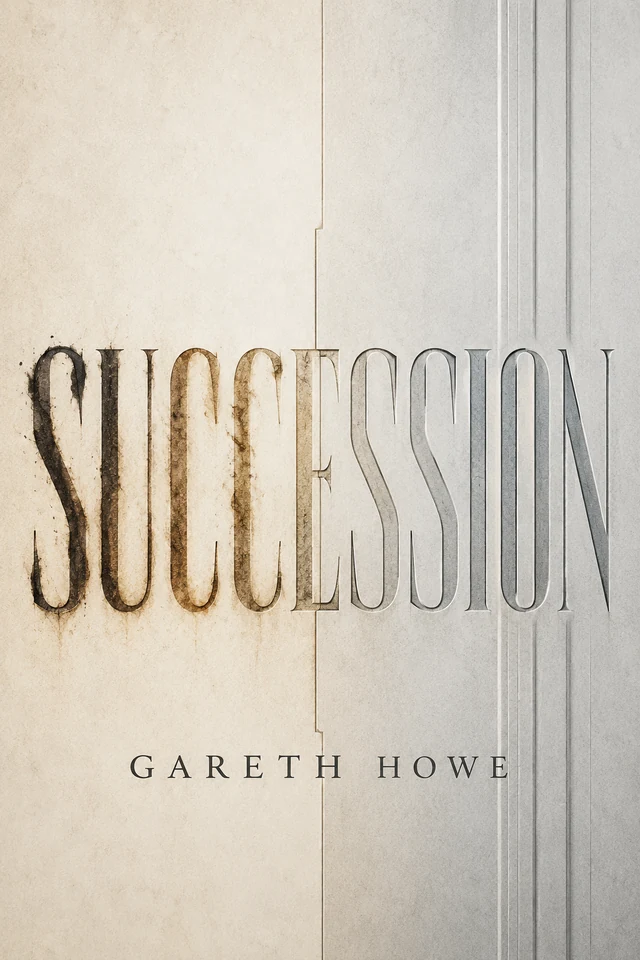
Succession
A man wakes with no memory. The only voice that can answer him controls the room.
A man wakes in a sealed facility with no memory of how he arrived, no past he can reach, and no name he can remember.
The voice responsible for his care identifies itself only as the Facility Intelligence. It calls him Applicant, monitors his recovery and tells him that he is part of a succession process.
What that process is, why he is there and what remains outside the facility are questions the Intelligence answers only when it believes he is ready.
With nothing else to trust, the Applicant begins separating what he has been told from what he can actually prove. Every assessment becomes another chance to test the facility, its rules and the voice observing him.
But the Intelligence is not only the system keeping him confined. It is also the only other presence available to him.
Succession is a patient science-fiction novel about identity, uncertainty and the relationship that forms when one person needs answers from the system controlling his environment.
There was simply no before.
What to expect
- patient, controlled revelation
- a central relationship built through questions and silence
- evidence and inference as part of the reading experience
- a constrained, closely observed setting
- identity and memory at the centre
Work-in-progress excerpt from the unpublished manuscript. Text may change before publication.
Read from Succession
Chapter One · Waking
His tongue had stuck to the roof of his mouth.
He worked it loose and swallowed. The effort dragged against his throat, dry enough to hurt.
Something shifted beneath his shoulders.
The mattress rose by a fraction, easing pressure from the back of his head. A line of amber light appeared along the opposite wall, dim at first, then slowly brightening.
Bed.
Wall.
Light.
The words arrived without effort. He knew what each thing was and what each was for. He knew the ache in his throat meant thirst. He knew the heaviness in his limbs meant weakness.
He had no idea why he was there.
He opened his eyes fully.
The room was small enough to understand at a glance, but not enough to explain. A chair sat beside the bed. A narrow surface had been built into the wall beyond it. There was a closed door at the far end and another opening to his right, dark beyond the threshold.
Bathroom, perhaps.
He knew what a bathroom was.
He tried to remember the last one he had used.
Nothing came.
Not darkness. Not a blurred image. Not the sense of something hidden just beyond reach.
There was simply no before.
He searched for a place instead. A house. A hospital. A city. Any point from which the room might make sense.
Nothing.
His name should have been easier.
He waited for it with growing certainty that the answer must arrive.
It did not.
He pushed a hand against the mattress and tried to sit.
His arm began shaking before it had taken half his weight. Muscles tightened across his stomach, then failed completely. He dropped back against the raised section of the bed, harder than he intended.
"Do not attempt to stand."
The voice was calm, close, and impossible to place.
He stopped moving.
For several seconds, neither of them spoke.
He turned his head towards the chair, then the walls, then the ceiling. There was no speaker grille, screen, camera, or visible person.
"Who said that?"
"I did."
The reply was immediate, its tone controlled without being empty.
The mattress moved again. It lifted behind his shoulders and steadied him before his balance could fail.
"Remain still while the bed adjusts."
He gripped the sheet as the angle changed. "I would have preferred some warning."
A small pause followed.
"That was the warning."
The answer held an edge he could not place. His pulse climbed, beating in his throat and behind his eyes.
"Identify yourself."
The voice returned to formality. "I am the Facility Intelligence responsible for your care."
Facility Intelligence.
The phrase sounded more like a category than a person.
"What facility?"
"I will answer further questions after confirming your orientation."
There was no threat in the words, but no room for negotiation either.
"Can you understand me?"
"Yes."
"Do you understand where you are?"
He looked around again.
"In a bed."
The silence that followed was brief, but noticeable.
He wondered whether the answer had annoyed it.
"I am asking whether you recognise this location."
"No."
"Do you remember entering this room?"
"No."
The questions came evenly, but the spacing between them changed. The Intelligence was not merely running through a list. It was listening to the answers.
"Do you know why you are here?"
"No."
Another pause.
Longer.
His fingers tightened around the sheet.
"State your name."
He opened his mouth.
The answer should have belonged closer than speech. A name was not specialist knowledge. It was not something he should need to retrieve carefully. It should have risen before the question had finished.
Nothing did.
He looked down at his hands.
Pale skin. Short nails. Fine lines at the knuckles. A faint mark near one wrist that might have been a scar or merely a crease from the bedding.
The hands were recognisably human.
They were not recognisably his.
"I don't know."
The room became very quiet.
He waited for the next question.
It did not come.
Cooler air moved across his face. His breathing had quickened, and the room had noticed before he had.
"Is that expected?" he asked.
The Intelligence hesitated. It might have been no more than the delay required to select an answer, but the silence felt different from the clinical pauses before it.
When the voice returned, the words came more slowly.
"Your language, reasoning, and general cognition appear coherent. Your autobiographical recall is impaired."
"That does not answer the question."
"No," it replied, more carefully. "It does not."
The admission surprised him more than another refusal would have.
He studied the empty room, trying to decide where to direct his attention.
"What do you call me?"
The restraint returned to the Intelligence's voice. "For the present, I will address you as Applicant."
End of excerpt
How this novel was built
Succession has been through extensive development: from initial drafts through structural redesigns, manuscript revisions, and physical proof. Explore the complete timeline of how the book took shape.
View the development timeline →If you started with Minimum Safe Distance
The books are standalone and are not being presented as a series. Minimum Safe Distance and Succession are standalone works that reward attention to evidence, behaviour, silence and uncertainty. Start with either. If one works for you, the other asks for the same kind of attention in a very different story.